Home/blog/Guides/How AI chatbots choose the brands they recommend
14 September 2026
How AI chatbots choose the brands they recommend
ChatGPT, Gemini, Claude and Perplexity do not have a fixed brand ranking. They combine knowledge gained from training with web pages retrieved at the time of the response, and break down each question into several sub-queries. In the AirOps study, ChatGPT cited only 15% out of 548,534 retrieved web pages. We explain what determines which brand is included in the response.
AI chatbots select brands from two sources: from the knowledge stored in the model during training, and from search results which they retrieve whilst composing a response. A brand appears when the model associates it with the question or finds it in sources it considers reliable. There is no fixed ranking here, as there is on Google. There is a pool of brands that the model associates with a given category, and there is a significant element of randomness as to which of them end up in a particular response.
How does the AI model know that your company exists?
The first source is training data. The model is trained on a huge collection of online texts gathered up to a specific date. If a company has been mentioned frequently and consistently (on its website, in trade media, directories, forums and reviews), the model may recognise it and name it without having to consult the internet.
This information has two limitations. It is limited to the data cut-off date, so new services, name changes or price list updates are not included. It also mainly covers brands that have been widely written about. A small service company, described on its own website and in two directories, is often not included in the database or is confused with another company. We explain the reasons why the model might not recognise a specific company in the text ChatGPT doesn’t know my company.
The second source is real-time searching. When the chatbot uses the internet, it retrieves pages from a search engine’s index and constructs its response based on them. OpenAI in documentation for their robots distinguishes between the ChatGPT search bot (OAI-SearchBot) and the bot that collects training data (GPTBot). For a long time, ChatGPT relied on the Bing index, and analyses from 2026 suggest that it also uses other sources and builds its own index. AI responses on Google (AI Overviews and AI mode) draw on Google’s index. The practical implication is this: a webpage that is not included in a given index, or which blocks the crawler, cannot be used as a source for an answer.
What happens between the question and the answer?
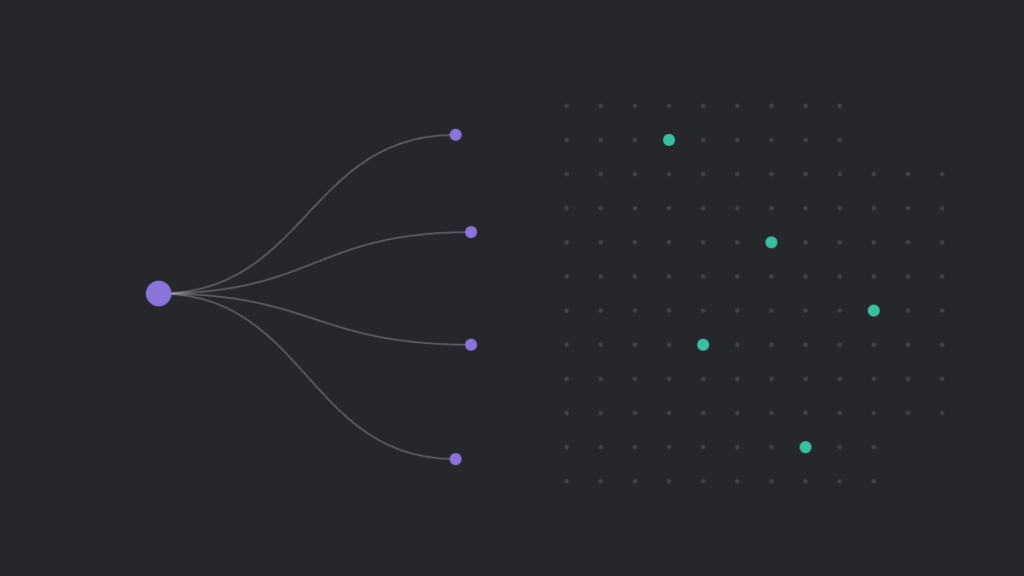
The model does not usually search for exactly what the user has typed. It breaks the query down into several sub-queries (a process known as ‘fan-out’), retrieves results for each of them, and only then constructs a response based on this information. Google confirms in Search Central documentation, …that AI Overviews and AI mode can generate multiple related searches across subtopics and different data sources.
Example: for the query „what invoicing software is suitable for a sole trader”, the model can check prices, bank integrations and customer support separately KSeF and user reviews. Each of these search queries yields different results and different pages to cite. This is why the selection of search queries for measurement differs from the selection of keywords: what matters is search intent, rather than volume.
Fan-out
What happens between the question and the answer?
01
User's question
Which invoicing software is best for a sole trader?
02
Supplementary enquiries
Prices. Bank integrations. KSeF support. User reviews.
03
Pages downloaded
The model retrieves results for each query separately, not for the original query
04
Response with citations
Some of the downloaded pages are included in the response; the rest are omitted
The mechanism for breaking a query down into sub-queries is called ‘fan-out’. Google confirms this in its Search Central documentation.
the queries triggered at least two additional searches
32,9%
the pages cited came exclusively from auxiliary queries
95%
The related queries had no search volume in the keyword tools
15%
of the downloaded pages were cited, out of 548,534 downloads
Source: AirOps, report on searches and citations in ChatGPT, March 2026.
aeloapp.io
This leads to two possibilities. A page may be found but still not appear in the search results. And as for citation It is often the questions that nobody tracks using traditional SEO tools that make the difference. That is why a high ranking on Google does not directly translate into an appearance in AI answers; more on this in the article Visibility in AI and SEO and on the website SEO, GEO and AEO: the differences.
What determines whether a brand is included in the results?
Mentioned in numerous independent sources
The model builds a picture of a category based on what it reads from a variety of sources. A brand described on its own website, in comparisons, industry rankings, reviews and catalogues is more likely to be included in the pool from which the model makes its selection. In a study by SparkToro and Gumshoe.ai The lists of recommended brands almost always differed, but the leading brands in the headphones category appeared in 55–77% responses. Brands from this group appear regularly. Brands outside this group appear almost never. We refer to the missing signal, which means there is no basis for replacing the company, as barrier.
Clear-cut facts about the company
What do you do, for whom, in which region, how much does it cost, and how do you stand out from the competition? If the website, Company Profile on Google whilst directories provide different names, addresses or ranges of services; the model often combines this information incorrectly or repeats out-of-date data. A separate issue is the variants of the name itself: abbreviations, former names, and spellings without Polish characters, i.e. brand aliases. We collect facts about the brand in Brand awareness, that is to say knowledge graphs based on the indexing of your website, scans and citations. This is supplemented by a form Brand identities.
Content that answers the guiding questions
Since the model breaks the question down into parts, it looks for specific details: a price list, a comparison with alternatives, a description, and who the service is for – and who it isn’t for. A webpage featuring phrases such as „comprehensive service” and „personalised approach” offers him nothing he could quote. The difference between what the model should find and what is actually on the page is described by the concept content gap. In research by academics from Princeton and IIT Delhi, which introduced the concept of GEO, the inclusion of statistics, quotations and sources in the text increased its visibility in generative responses by up to 40% (under experimental conditions, not in a specific chat).
Access for robots
The website must be indexed on Google and Bing (you can check the latter’s index at Bing Webmaster Tools), and the robots.txt file must not block AI search engine bots. The key content should be in the page’s HTML code. In Vercel analysis None of the major AI bots execute JavaScript, so text loaded via a script may be invisible to them. They also help structural data, and that is a separate matter llms.txt file, around which more promises have accumulated than confirmed facts.
Why does AI recommend competitors but not your brand?
The reasons are usually quite mundane. A competitor features in comparison articles and rankings that the model reads when carrying out a search. It has more reviews on websites that the search engine indexes. Their website provides direct answers to questions about price and scope, whereas yours does not. Or perhaps it has been online for longer and has already made it into the training data. We explore this further on the website Why does AI recommend the competition?.
A separate case is a brand that the influencer is familiar with but does not recommend. In such cases, it is usually the lack of independent, third-party coverage that is the issue, rather than a lack of content on the brand’s own website. We discuss this in the text He knows it, but doesn’t recommend it, and in practice this can be seen in case of a lime manufacturer: visibility increased from 31% to 63% over five weeks, and the recognition test yielded the same result in both measurements.
None of these reasons is permanent. The sources cited by the model in relation to questions about your sector highlight where other brands are present and where yours is missing. On this basis, we prepare tasks, e.g. a list of websites where it’s worth setting up a profile. Local businesses competing for search results containing the name of their town will find more information on the website Aelo for small businesses, and the shops on the website Aelo for e-commerce.
How can you find out how a model perceives your brand?
The module is used for regular measurements Visibility. It asks the same questions across four models (ChatGPT, Claude, Gemini and Perplexity) at regular intervals and records how often a brand appears, which other brands feature in the same responses, and which sources the model drew upon. We ask the questions without mentioning the brand name, that is, in a neutral scan. Agencies carrying out such surveys for clients can find further details on the website Aelo for agencies, and on-site SEO agencies Aelo for SEO agencies.
See who the AI lists in your category
Instead of guessing which brands he associates with your industry, ask him these questions systematically and record the results. A Free account gives you 250 AeloCoins to get you started and a full brand report: mentions, citations, sources and a list of barriers to remove.
The scope of the plans, query limits and terms and conditions for the Free account are set out in price list.
FAQ
How does ChatGPT know about my company?
From two sources at once: from the texts used to train the model, and from the web pages it fetches at the time of the response, if it uses a search engine. The first source ends on the data cut-off date, whilst the second covers only pages currently in the search engine’s index and accessible to the bot.
Is a good website enough for AI to recommend a brand?
No. A company’s own website is sufficient for the model to accurately describe a company it is already familiar with. For recommendations, signals from outside the company’s own domain are required: comparisons, rankings, reviews and industry publications. We describe this mechanism in the text He knows it, but doesn’t recommend it.
Will the model mention the brand if they find it in a search engine?
Not necessarily. In the AirOps study, ChatGPT cited 15% webpages that it had downloaded. Finding a webpage is a necessary condition, but not a sufficient one.
What is the difference between a reference and a quotation?
Mention this is the brand name mentioned in the reply. Citation This involves citing your website as a source, usually with a link. A brand name may be mentioned without any citations whatsoever, and vice versa.
Can I pay for an AI to recommend my business?
Not in the body of the reply. Advertisements in chats are labelled and displayed separately from replies. Whether they appear in the reply itself depends on the sources the model uses.
Co-founder of Aelo, she is responsible for product, content and communications. She has been designing and building websites for over ten years. At Aelo, she decides what goes into the app, what the reports look like and how we describe the measurement method.
The AI gives a different response every time, because it generates text with an element of randomness; each time it is run, it may come up with something different…